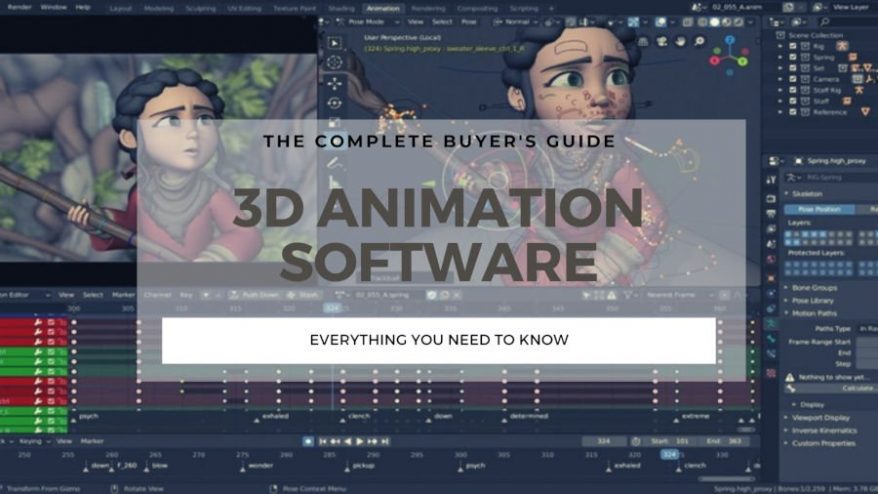
The digital creative landscape is in constant flux, and few areas evolve as rapidly as 3D animation software. As we step into 2026, the lines between traditional digital content creation (DCC) platforms and real-time game engines continue to blur, while artificial intelligence (AI) and cloud computing are reshaping workflows. Whether you're a budding artist crafting your first scene or a seasoned professional seeking to optimize your pipeline, choosing the right 3D animation software is more critical and complex than ever.
This comprehensive guide dives deep into the best free and commercial 3D animation software available in 2026, evaluating their strengths, ideal use cases, and the innovations driving their development. We'll help you navigate this dynamic environment, offering insights to match your project needs, skill level, and budget.
The Evolving World of 3D Animation Software in 2026
At its core, 3D animation software encompasses specialized computer programs designed for creating moving images within a three-dimensional digital environment. These powerful tools empower artists to construct complex virtual worlds by modeling objects, applying textures, simulating physics, and generating motion with depth, perspective, and often, stunning realism. Far beyond simple digital drawing, 3D animation simulates properties like lighting, shadows, and kinematics to produce visuals ranging from hyper-realistic to highly stylized.
The essential workflow for any 3D animation project typically involves several key stages:
- Modeling: Building geometric forms, whether organic characters or hard-surface objects, using polygons, NURBS, or other primitives.
- Texturing & Materials: Applying surface properties, colors, and patterns to models to give them visual detail and physical characteristics.
- Rigging: Creating a digital skeletal hierarchy and control system (a "rig") that allows animators to pose and deform characters and objects naturally.
- Animation: Bringing models to life through various techniques, most commonly keyframing (defining poses at specific intervals for smooth transitions), but also motion capture, procedural animation, and simulation.
- Lighting: Setting up virtual light sources to illuminate scenes and create mood, depth, and realistic shadows.
- Rendering: The final process of generating a 2D image or sequence of images from the 3D scene, calculating all lighting, textures, and effects. Modern rendering can be offline (pre-rendered) or real-time (instantaneous).
From the rudimentary computational experiments of the 1960s to the groundbreaking fully computer-animated feature film Toy Story in 1995, 3D animation has continually pushed technological boundaries. Today, its applications are ubiquitous: blockbuster films, immersive video games, architectural visualizations, medical simulations, product design, and virtual reality experiences all rely on sophisticated 3D animation software.
Choosing Your 3D Animation Software: Key Considerations
The sheer variety of 3D animation software available can be overwhelming. To make an informed decision in 2026, consider these crucial factors:
- Budget: Free vs. Commercial: Are you a hobbyist, a student, an indie developer, or part of a large studio? Your budget will heavily influence your options. Free tools offer incredible value, while commercial software often provides robust support, advanced features, and industry-standard workflows.
- Project Focus: What kind of 3D content do you primarily want to create?
- Character Animation & VFX: Maya, Houdini, Blender.
- Motion Graphics & Broadcast: Cinema 4D.
- Architectural Visualization & Product Design: 3ds Max, Blender.
- Game Development & Real-time Content: Unreal Engine, Unity, Blender.
- Procedural Effects & Simulations: Houdini.
- Learning Curve & Community Support: Some software is notoriously difficult to master but offers unparalleled power (e.g., Houdini), while others prioritize user-friendliness (e.g., Cinema 4D). A strong online community, tutorials, and readily available documentation can significantly ease the learning process.
- Integration & Workflow: How well does the software integrate with other tools in your pipeline (e.g., video editors, compositing software, game engines)? A seamless workflow is crucial for productivity.
- Hardware Requirements & Future-Proofing: High-end 3D animation, especially with real-time rendering and complex simulations, demands powerful hardware. Consider software that is embracing new technologies like AI-assisted workflows, cloud-based collaboration, and advanced rendering techniques to ensure your skills remain relevant.
For a deeper dive into tailoring your choice to specific project parameters, explore our detailed guide: Choosing Your 3D Animation Software: Tools for Project Needs & Budget.
Top Contenders: Free and Open-Source 3D Animation Software
The open-source movement has delivered a powerhouse tool that rivals commercial offerings in both breadth and depth:
Blender: The Versatile Powerhouse
Blender stands as the undisputed champion of free 3D animation software in 2026, continually pushing the boundaries of what open-source can achieve. It's an incredibly comprehensive suite, encompassing not just modeling, rigging, and animation, but also sculpting, VFX compositing, video editing, and even game creation. Its development is community-driven, meaning it benefits from rapid iteration and a passionate user base.
- Strengths: All-in-one solution, excellent for character animation, robust sculpting tools, powerful Cycles and Eevee render engines, extensive add-on ecosystem, strong community support, increasingly adopted by professional studios for specific tasks.
- Ideal For: Beginners, hobbyists, indie filmmakers, small studios, generalists, and professionals looking for a cost-effective, full-featured alternative.
- Tips for 2026: With ongoing improvements to its UI/UX and performance, Blender's learning curve is becoming more approachable. Dive into its vast library of free tutorials, and don't be afraid to experiment with its built-in Python scripting for automation.
Leading Commercial 3D Animation Software for Professionals
For high-end productions and specialized industry workflows, commercial 3D animation software continues to dominate, offering unparalleled robustness, integration, and dedicated support.
Autodesk Maya: The Industry Gold Standard
Autodesk Maya remains the reigning king for feature film, television, and high-end video game production. Renowned for its unparalleled character rigging, animation tools, and simulation capabilities, Maya has been the backbone of countless visual effects masterpieces. In 2026, Maya continues to integrate AI-assisted rigging and animation features, streamlining complex processes and accelerating artist workflows.
- Strengths: Best-in-class character animation, powerful rigging and modeling tools, robust fluid and cloth simulations (Bifrost), extensive scripting capabilities (MEL, Python), deep integration into professional pipelines.
- Ideal For: Character animators, VFX artists, large animation studios, game developers requiring high-fidelity character work.
- Tips for 2026: Maya's learning curve is steep, but its professional rewards are immense. Focus on mastering its core animation principles and take advantage of its MASH procedural animation toolkit for motion graphics and abstract effects.
Maxon Cinema 4D: Motion Design's Darling
Cinema 4D (C4D) by Maxon is a favorite among motion graphic designers, broadcast artists, and general 3D artists due to its intuitive interface and powerful MoGraph module. Its integration with Adobe Creative Suite (especially After Effects) is seamless, making it an ideal choice for artists transitioning from 2D motion graphics into 3D.
- Strengths: User-friendly interface, exceptional MoGraph toolkit for procedural animation, robust rendering options (Redshift integration), excellent workflow with Adobe products, stable and reliable.
- Ideal For: Motion designers, broadcast artists, graphic designers, product visualization, architects seeking easy 3D integration.
- Tips for 2026: Explore its asset browser for quick scene population and leverage its field system for precise control over effects. Its ease of use doesn't mean it lacks depth; dig into XPresso for powerful node-based workflows.
SideFX Houdini: Master of Procedural VFX
Houdini stands apart with its unique node-based, procedural workflow. Instead of direct manipulation, artists build systems that generate geometry, simulations, and effects algorithmically. This makes it incredibly powerful for complex visual effects, destruction simulations, fluid dynamics, and crowd animation, often seen in major blockbusters.
- Strengths: Unmatched procedural capabilities, industry-leading simulation tools (fluids, particles, destruction, cloth), highly flexible and customizable, excellent for generating complex environments and effects.
- Ideal For: VFX artists specializing in simulations and procedural generation, technical directors, R&D departments in large studios.
- Tips for 2026: Houdini has a very steep learning curve. Start with its free Apprentice version and focus on understanding its core procedural mindset rather than just memorizing tools. It’s a career-defining skill for those committed.
Autodesk 3ds Max: Architecture and Game Development Staple
3ds Max continues to be a dominant force in architectural visualization (arch-viz), product design, and environmental art for game development. Known for its robust modeling tools, extensive library of modifiers, and powerful rendering capabilities (V-Ray, Corona Renderer), it excels at creating detailed scenes and realistic stills.
- Strengths: Excellent polygon and spline modeling, extensive modifier stack, powerful rendering ecosystem, strong scene management tools, widespread use in specific industries.
- Ideal For: Architectural visualization artists, interior designers, product designers, game environment artists, CAD integration.
- Tips for 2026: Leverage its scripting capabilities (MAXScript) for automating repetitive tasks. Explore its data export options for seamless integration with game engines.
Game Engines: Unreal Engine & Unity for Real-Time Production
While traditionally for games, Unreal Engine and Unity have transformed into potent 3D animation software platforms for virtual production, real-time cinematics, and interactive experiences. Their ability to render photorealistic visuals instantaneously makes them invaluable for rapid prototyping, previsualization, and even final pixel output in film and television.
- Strengths: Real-time rendering, interactive capabilities, virtual production tools (e.g., in-camera VFX with Unreal Engine), expansive marketplaces for assets, powerful visual scripting (Blueprint in Unreal), growing cinematic toolsets.
- Ideal For: Game developers, virtual production specialists, interactive media creators, architectural walkthroughs, anyone needing fast iteration and high-fidelity real-time visuals.
- Tips for 2026: Learn the basics of node-based material creation and lighting to unlock their visual potential. Embrace their strong asset pipelines for efficient content creation.
To understand how these powerful platforms are changing the industry, delve into Navigating 3D Animation Software: From Game Engines to AI Workflows.
The Future is Now: AI, Real-Time, and Cloud in 3D Animation
The year 2026 solidifies several key trends in 3D animation. AI is increasingly assisting with tedious tasks like rigging, motion capture clean-up, and even generating animation cycles, democratizing access and speeding up production. Real-time rendering, largely driven by game engines, is no longer just for games; it's central to virtual production, allowing filmmakers to see final shots on set. Cloud-based collaboration and rendering services are enabling distributed teams to work seamlessly and access immense computational power without local hardware limitations. These innovations are making 3D animation more accessible, efficient, and capable than ever before.
Conclusion
The landscape of 3D animation software in 2026 is rich with powerful options, catering to every conceivable project and budget. From the open-source versatility of Blender to the industry-leading robustness of Maya and the procedural might of Houdini, each tool offers a unique path to bringing your creative visions to life. The "best" software isn't a universal truth; it's the one that aligns perfectly with your specific needs, helps you learn and grow, and empowers you to tell your story in three dimensions. As the industry continues its rapid evolution, embracing new technologies like AI and real-time workflows will be key to staying ahead in this exciting field.